CISCE has released the specimen question papers for the ICSE Class 10 board exams of 2027 on its official website, cisce.org. The biggest change for students and parents: a much larger share of questions now tests application, analysis and evaluation, not just recall. Education news reports put this share at around 40% to 50% of the paper.
If your child is in ICSE Class 10 this year (or moving into Class 10 next year), here is what the new papers mean and how to prepare for them between now and the board exam.
What has CISCE released?
- ICSE Class 10 specimen papers for 2027, with answer keys or marking guidelines for the main subjects: English Language, Literature in English, Mathematics, Physics, Chemistry, Biology, History & Civics and Geography, along with some newer subjects such as Robotics and Artificial Intelligence.
- Specimen papers for ICSE Class 9, so Class 9 students can see early what the Class 10 board paper will expect.
- The 2026 main and improvement question papers, which are useful for timed practice.
You can download them free from cisce.org (look for the ICSE specimen question papers for 2027 under the examination or publications section). CISCE notes that the actual board papers may differ from the specimens in format and content, so treat them as a guide to the style of questions, not a preview of the real paper.
What are “higher-order thinking” questions?
A recall question asks a student to repeat what is in the textbook: a definition, a date, a formula. A higher-order question asks the student to use what they know in a new situation. In the 2027 specimen papers this shows up as:
- Case-based and real-life questions in Physics, Chemistry, Biology, Mathematics and the humanities, where students read a short situation and answer questions about it.
- Assertion-reasoning and contextual MCQs, so even the objective section checks understanding, not memory alone.
- Application and analysis questions: explain why, compare, predict what will happen, choose a method and justify it.
This follows the move towards competency-based learning under NEP 2020, which both CISCE and CBSE are following. The biggest shift is in how the syllabus is tested, with fewer questions that reward memorising alone.
Why this matters for marks
Students who prepare only by memorising answers often do well in school tests but lose marks in the board paper, because the board question looks unfamiliar. When close to half the questions test application, a student who understands concepts and has practised unfamiliar questions has a clear advantage. Two things make the biggest difference:
- Concept clarity in every chapter, especially Mathematics, Physics and Chemistry, where most application questions come from.
- Regular practice with exam-style papers, checked by someone who knows how the board awards marks.
How to use the specimen papers: a 4-step plan
1. Read before you write
Go through each specimen paper once without attempting it. Note the sections, marks per question, number of case-based questions and the type of MCQs. This takes 20 minutes per subject and removes surprises on exam day.
2. Attempt each paper in exam conditions
Sit for the full time, with no phone and no book, once your syllabus for that subject is complete. Mark which questions felt unfamiliar, not only which ones were wrong.
3. Check with the answer key, then find the pattern
Compare with the official answer key or marking scheme. Look for patterns: did your child lose marks in case studies, in “give reasons” questions, or in long answers? That pattern tells you what to practise next, chapter by chapter.
4. Practise more papers of the same type
One specimen paper per subject is not enough practice. Follow it with chapter-wise tests and full-length mock board exams written to the same pattern, and go through the corrections after each one.
Subject-wise tips
- Mathematics: practise word problems and real-life applications of each chapter, not just textbook sums. Show every step, since method marks matter. Our guide on how to score 95%+ in Class 10 Maths has a detailed plan.
- Physics and Chemistry: for every law or reaction, ask “where is this used?” and “what happens if one condition changes?”. These are typical case-based questions.
- Biology: practise diagram-based and experiment-based questions, and explain processes in your own words.
- History & Civics and Geography: practise source- and map-based questions and explain causes and effects rather than listing facts.
- English: read unseen passages regularly and practise answering inference questions, which test understanding beyond the text.
A simple timeline from now to the board exam
- November: finish the syllabus and attempt the specimen papers subject by subject.
- December to January: full-length mock board exams in every subject, with corrections and revision of weak chapters.
- February: revision, previous years’ papers and timed practice; no new topics. The exams begin on 15 February 2027: see the full ICSE date sheet 2027.
For a detailed month-by-month plan, read our ICSE Class 10 preparation timetable and the 100-day board exam plan.
How Universal Tutorials prepares ICSE students for this pattern
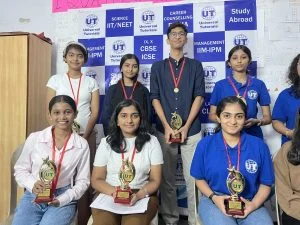
Since 1998, Universal Tutorials has prepared ICSE students in Navi Mumbai for the board exam. In ICSE 2025, our student Arsh Chaudhari secured All India Rank 1 with a perfect 500/500. Our approach matches what the new specimen papers reward:
- Concept-first classroom teaching at our centres in Kharghar, Vashi, Nerul, Sanpada and Koparkhairane.
- Weekly chapter-wise tests and full-length mock board exams set to the latest ICSE pattern, including application-based questions.
- Answer sheets corrected by experienced teachers as per the board marking pattern, with model answers after every test.
- Doubt solving and performance reports, so parents know exactly where their child stands.
See our ICSE Class 9 & 10 coaching programs, or if your child only needs test practice, the ICSE test series at your nearest UT centre. Students outside Navi Mumbai can take the UTudaan online test series from home. Hear from our students and parents on our video testimonials page.
Frequently asked questions
Will the ICSE 2027 board paper be exactly like the specimen paper?
No. CISCE says the actual papers may differ in format and content. The specimen papers show the style and level of questions, so use them alongside chapter-wise practice and mock exams.
Has the ICSE Class 10 syllabus changed for 2027?
The main change in the 2027 specimen papers is in how questions are framed, with more application and analysis. Always check the current syllabus for each subject on cisce.org.
When should my child start solving specimen papers?
Read them now to understand the pattern. Attempt each one in exam conditions once the syllabus for that subject is complete, ideally by November or early December, and then move on to full-length mock board exams.
Are the specimen papers useful for Class 9 students?
Yes. CISCE has also released Class 9 specimen papers. Practising this style of question in Class 9 builds the habit of thinking through unfamiliar questions well before the board year.
Want help preparing your child for the ICSE 2027 board exam? Call +91 77188 98822 or visit your nearest Universal Tutorials centre for a free counselling session.